Why your AC outdoor fan isn't spinning in New Mexico
Tell a local repair pro what your air conditioner is doing.
You go out back on a hot afternoon and the unit is dead quiet. The fan on top isn't turning. Inside, the air coming out of your vents is warm, or close to it, and with highs the way they get here, that's not something to sit on for long.
A fan that won't spin usually means one of a few things. The capacitor that gives the motor its start could be weak or gone. The motor itself could have failed. A tripped breaker, a bad contactor, or a wire that's come loose can all look the same from where you're standing. Some of these are simple fixes. Some mean a new motor. You can't tell which from across the yard, and guessing at it yourself risks the compressor, which is the expensive part to replace.
What matters right now is getting someone out who can open the unit, test the motor and the capacitor, and tell you straight what's wrong and what it takes to fix it. Not every outdoor fan problem is the same, and not every contractor handles it the same way. One with the right experience on your system, your brand, your setup, is going to get you a straight answer faster than calling around yourself.
That's what this page does. Send the details of what's going on, and you're matched with a contractor suited to your situation, someone who works on systems like yours. They'll reach out to you directly. You're not left dialing numbers during the hottest part of the day, waiting on hold, explaining the problem over and over to someone who may not even handle your kind of unit.
Once you send the form, that part is off your plate. Someone qualified is already on it.
A handful of things stop that fan from turning. The capacitor that gives the motor its initial kick can weaken and fail, which is the most common cause. The fan motor itself can seize or burn out, especially after years of running through New Mexico summers where the unit works hard most afternoons. A tripped breaker or a bad contactor in the outdoor unit can cut power to the fan while the rest of the system still hums. Dust and grit from dry, windy conditions can also build up around the motor bearings and slow it down until it stops. Whatever the cause, the indoor coil still gets refrigerant but has no airflow to pull heat from outside, so it can ice over and your system loses its ability to cool. The longer it runs like this, the more strain it puts on the compressor, which costs far more to replace than a fan motor or capacitor.
Before you get your air conditioner repairAfter you get your air conditioner repair
What a weak capacitor looks like
A capacitor that's failing doesn't always quit outright. Sometimes the fan hums but doesn't turn, and you can get it spinning for a moment with a push, which is a sign the capacitor is the issue. Other times it just sits there, silent. Capacitors wear out faster in units that run hard for months at a stretch, and that's the pattern in New Mexico, where the compressor and fan are working through long stretches of 90 and 100 degree afternoons. The part is small, a couple inches across, but it carries the charge the motor needs to start moving. Once it drops below that threshold, the motor gets power but can't turn.
What happens if it waits
The compressor inside your outdoor unit keeps running even when the fan doesn't, and it depends on that fan pulling air across the coil to shed heat. Without it, the coil gets hotter than it's built for, and the compressor runs hotter along with it. Some systems shut themselves down before damage sets in. Others don't, and a compressor that overheats enough times can fail for good, which costs a lot more to replace than a fan motor or capacitor. The longer a dead fan runs with the compressor still cycling, the more that risk builds, and it builds faster on a 100 degree day than it does on a mild one.
Your outdoor unit runs two motors off one capacitor, one for the compressor and one for the fan. That capacitor has a separate section for each motor, so one section can wear down while the other still carries its load. That's how the compressor keeps running with the fan dead still. The fan motor itself sits out in the sun season after season, and the bearings inside it dry out over the years. Once they seize, the motor still hums when the thermostat calls, but the blade won't turn. A seized motor doesn't shut itself off. It keeps pulling power and building heat, and that's often what trips the compressor off on high pressure a few minutes later. Some units switch power to both motors through a single contactor, and if those contacts burn or pit, they can drop the fan side while the compressor keeps going. Dust and cottonwood seed work into the motor housing all summer too, and packed tight, that alone can keep the blade from spinning even with a good motor underneath.
Why the fan alone stops
The outdoor unit has two separate motors, one for the compressor and one for the fan, so the compressor can keep running while the fan sits still.
A dual run capacitor serves both motors from one can, so a weak section can drop the fan while the compressor side still gets by.
The fan motor bearings take direct sun for years, and once they seize, the motor hums at startup but never turns the blade.
A stuck or failed fan motor still draws power and heats up, which is why the compressor often trips off on high pressure soon after.
Some outdoor units use a contactor to switch power to both motors together, and a contactor with burnt or pitted contacts can cut power to the fan side only.
Dust and cottonwood seed pack into the fan motor housing over a dry New Mexico summer, and that buildup alone can keep the blade from turning freely.
A dead fan with the compressor still running is the kind of problem that gets worse the longer it sits. The compressor is built to move heat with air pulling across the coil behind it. Without that air, heat has nowhere to go, and a compressor working against trapped heat can overheat and fail outright, which turns a capacitor repair into a far bigger one. New Mexico summers don't give you room to wait this out. A licensed contractor can tell in minutes whether it's the capacitor, the motor, or something else, and knowing which one it is changes what happens next. Once you send the request, that part is off your plate. You're not the one calling around trying to find someone free this week. Send the request and let the right contractor take it from here, while your system is still fixable instead of finished.
Fan running normal
The fan on top spins steady and the unit hums along without any strain. Air coming off the coil moves through the fins and out past the shroud. Nothing rattles, nothing hums without turning. The disconnect box stays untouched and the lines running into the wall stay cold to the touch.
Fan stopped, compressor still on
The fan sits still while the unit keeps drawing power, maybe humming or clicking without turning. Dirt sits packed in the fins and rust shows on the shroud from years of New Mexico sun. The compressor can keep running behind a dead fan, and that's when the real damage starts.
Call It In Now Or Wait It Out
Call it in now
A tech catches the capacitor or motor before the compressor runs long enough to overheat and shut itself down.
The repair stays small, usually a single part swapped out, instead of the compressor needing attention too.
Your house stays close to set temperature since the fix happens before the warm air inside gets too far along.
You get the AC back to normal operation without a second problem showing up from the first one sitting too long.
Scheduling now means you're not competing with every other homeowner calling in the middle of a heat wave.
Wait it out
The compressor keeps running without airflow across the coil, and heat has nowhere to go while it does.
A compressor that overheats enough can trip a safety switch, or it can fail outright and stop working for good.
Warm air keeps coming through your vents the whole time, so the house doesn't cool down in the meantime.
What started as a cheap part, a capacitor, can turn into a compressor replacement, which costs far more.
The longer the unit runs this way, the higher the risk that a small fix becomes a whole new outdoor unit.
New Mexico air is dry, but summer dew points here still average 45°F across June, July and August, according to NOAA climate data. That's enough moisture that your outdoor fan has real work to do moving air across the coil to shed heat. When the fan quits and the compressor keeps running, that coil loses its one way of dumping heat into the air outside. On a dry, hot afternoon that backup happens fast, and it's part of why a dead fan next to a running compressor turns into a bigger repair the longer it sits.
NASA POWER T2MDEW county cells weighted by homes
The fan spins steady, the unit hums low and even, and the lines running up to the disconnect box carry power without strain.
The grille is caked with dirt and the fan sits still while the unit draws power next to the undisturbed disconnect box.
Power costs 14.85 cents per kilowatt-hour statewide
At 14.85 cents a kilowatt-hour, running the compressor on a system with a dead fan doesn't save you anything. It just means you're paying for a unit straining against heat it can't shed, right up until it shuts itself down. Getting the fan fixed quickly keeps that bill from climbing for nothing.
EIA-861 2025 statewide residential average
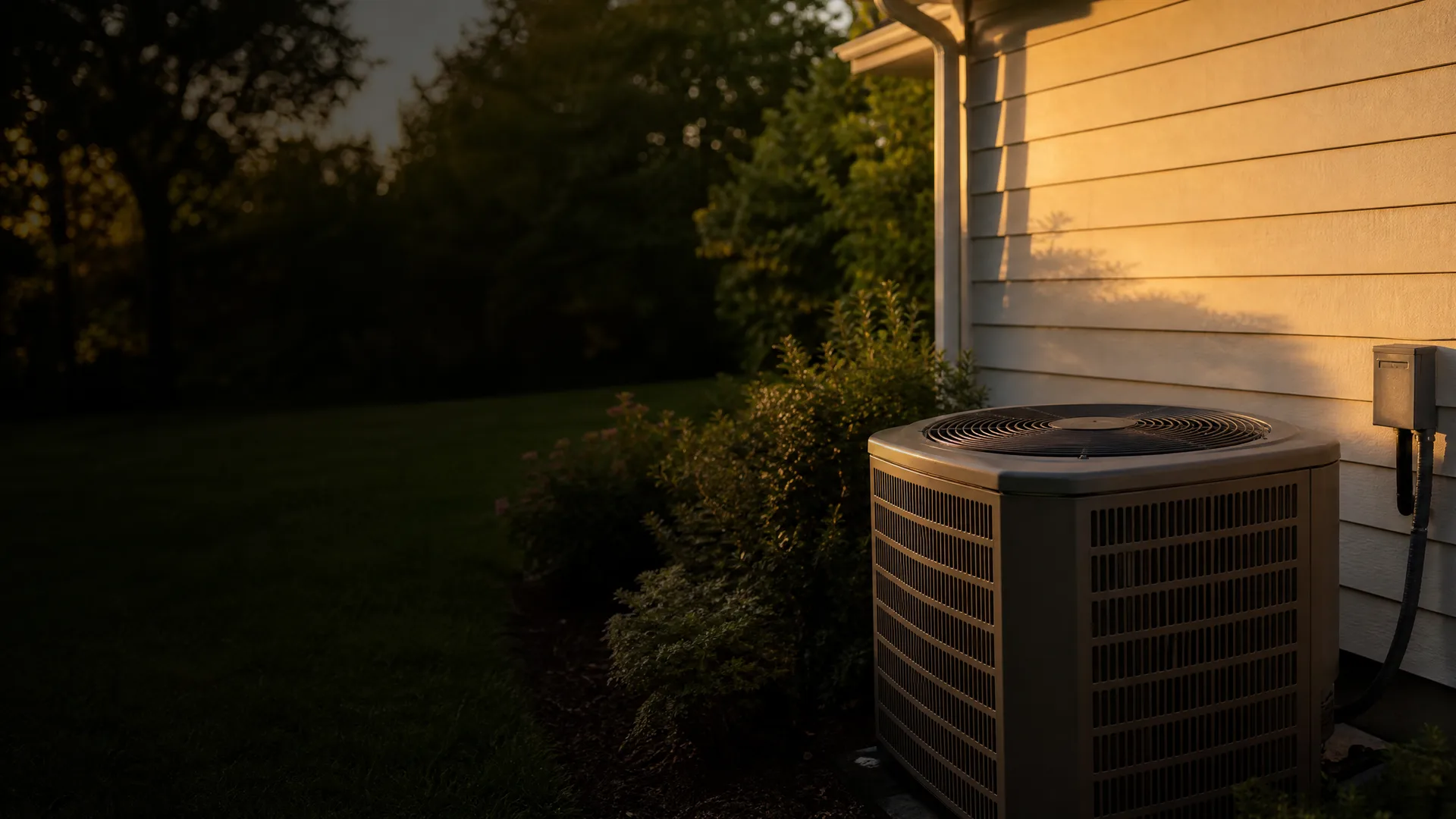
It's past seven and the light's gone low and gold across the yard. You're out back because the house finally felt warm enough to check. The condenser is running, you can hear the compressor's low hum, but the fan on top sits still. No blur of blades, no draft coming off it. You crouch near the grille and the air there is dead calm, just heat sitting against the coil with nowhere to go. A moth circles the unit, drawn to nothing moving. Somewhere inside, your thermostat is still calling for cool air that isn't coming. You stand there a second longer, listening to the hum, watching the fan that won't turn.
A quiet fan means something specific is wrong
A dead fan on top of your unit almost always comes down to the capacitor or the motor. Nothing else makes an outdoor unit run that quietly while the compressor keeps going. You don't need to guess at it, and you don't need to keep opening the panel to check on it between now and when someone looks at it.
Once you send the form, you're not the one tracking down who's free or who covers your area. A contractor who takes on jobs like yours gets your information and reaches out to you directly. That part of it is off your plate the moment it's sent.
A pro who works on air conditioners
Get the air conditioner repair search off your mind today.