An outdoor air conditioning condenser unit on a concrete pad beside a house with horizontal siding, with an electrical disconnect box on the wall and shrubs to the right in low evening light.

Matched to your air conditioner job

Why your AC compressor won't kick on in New Mexico

A compressor that stays silent in New Mexico heat usually points to one of a few things: no power getting to it, a capacitor that's failed, or a safety switch that's shut it down to protect the system. This page walks through what separates those causes. Once you know what you're dealing with, a contractor who handles this can take it from there.

Find my pro

If your compressor won't kick on, the outdoor unit sits there doing nothing while the indoor fan still blows, usually warm air. That split is the clue. Most of the time it comes down to power not reaching the compressor, a capacitor that's gone bad, or a high pressure switch that's tripped and shut things down on purpose. In a New Mexico summer, with the unit working hard day after day in dry heat, that switch is often doing its job, not failing at it. A dirty outdoor coil or a condenser fan that's stopped turning will make the system run hotter than it should, and the safety switch will cut the compressor rather than let it keep pushing against that. A bad capacitor shows up differently. You might hear the fan try and stall, or hear a hum and nothing move at all. Either way, the compressor not starting is the system telling you something specific failed, not that the whole unit is done.

A woman with long wavy brown hair in a grey ribbed sweater sits on a couch indoors, looking toward a window, with a potted palm-like plant and fireplace behind her.
A woman with long brown hair wearing a green V-neck top and beige cardigan sits on a light sofa, looking off to the side, with a dining table, lamp and framed picture in the background.
A woman with long dark hair in a cream knit sweater sits on a beige sofa indoors, looking toward a bright window with a houseplant and framed picture in the background.
A woman with long dark hair in a green knit sweater sits on a couch indoors, smiling and looking toward a window with a blurred room behind her.

Why is the outside unit silent but the fan still runs?

You've probably noticed the thermostat is set right and the fan inside is still running, but the air coming out is warm. Outside, the unit is quiet. No hum, no click, nothing turning. Maybe you've gone out and touched the side of it, half expecting it to just need a nudge. If this has been going on for more than a few hours, the house is heating up with it, and in a New Mexico summer that matters most for anyone at home all day, kids, older family members, pets. A compressor that won't start doesn't fix itself by waiting.

A gray outdoor air conditioner condenser unit on a concrete pad beside a house with horizontal lap siding, with a wall-mounted disconnect box and conduit at left and a green shrub and mulch bed at right.

Running normally

The unit hums steady and low, the fan inside turning warm air into something that actually cools the house. In July and August that sound is the difference between a livable afternoon and one spent waiting it out. The conduit runs clean from the disconnect to the unit, carrying power the compressor needs to keep up with the heat outside.


An outdoor air conditioner condenser unit on a concrete pad beside a house with horizontal lap siding, with a conduit running to a gray electrical disconnect box on the wall.

Compressor not starting

The unit sits against the siding quiet. No hum, no click, no vibration through the conduit. The disconnect box on the wall might still have the switch thrown, but nothing downstream is answering. Inside, the fan keeps moving air that never gets cold, which is how most people in New Mexico notice something's wrong before they know what it is.

An outdoor air conditioning condenser unit on a concrete pad beside a house with horizontal siding and a concrete foundation, with dry brown leaves on the ground to either side.
Before you get your air conditioner repair
A gray outdoor air conditioning condenser unit on a concrete pad beside a house with horizontal lap siding, with a wall-mounted disconnect box and conduit, and shrubs to the left.
After you get your air conditioner repair

The thermostat doesn't power the compressor directly. It sends a low voltage signal to a contactor, a small switch in the outdoor unit, and that contactor is what closes the circuit and sends real power to the compressor. If the contactor's contacts have pitted or burned out from years of cycling on and off in New Mexico heat, the signal stops there and the compressor never hears it.

Even with power reaching it, the compressor motor needs a push to start turning. That push comes from the run capacitor. A weak one can leave the motor humming or trying to start without ever catching.

There are also two switches built into the refrigerant line, one for high pressure and one for low, and either can cut power to protect the compressor if pressure moves outside a safe range. A dirty outdoor coil is a common reason pressure climbs that high. Some units also hold the compressor off for a few minutes after a stop before letting it restart.

How the compressor gets its signal

  • The compressor only runs when the thermostat calls for cooling, a low voltage signal closes a contactor, and that contactor is what actually sends power to the unit.
  • A run capacitor gives the compressor motor the extra push it needs to start, and when it weakens the motor can hum or try and still fail to turn.
  • High pressure and low pressure switches sit in the refrigerant line and will cut power to the compressor if pressure moves outside a safe range.
  • A dirty outdoor coil blocks airflow, pressure climbs, and the high pressure switch can shut the compressor off before it ever gets going.
  • A short cycle timer in some units holds the compressor off for a few minutes after a stop, which protects it from restarting against high pressure.
  • The contactor itself has a set of contacts that pit and burn over years of cycling, and once they fail the signal never reaches the compressor at all.
An outdoor air conditioner condenser unit on a concrete pad beside a house with beige horizontal siding and a stone-veneer base, with refrigerant lines running to a gray wall-mounted electrical box, surrounded by dark mulch, a flowering shrub and an evergreen on the left.
The unit sits clean and quiet between jobs, the pad clear and the disconnect box closed up tight beside it.
An outdoor air conditioning condenser unit on a concrete pad beside a house with light vinyl siding, an electrical disconnect box and conduit on the wall, bare shrubs and mulch to the right, and a concrete walkway in the foreground.
Bare shrubs and a dead-quiet pad: no hum, no click, just a disconnect box that may be the reason why.
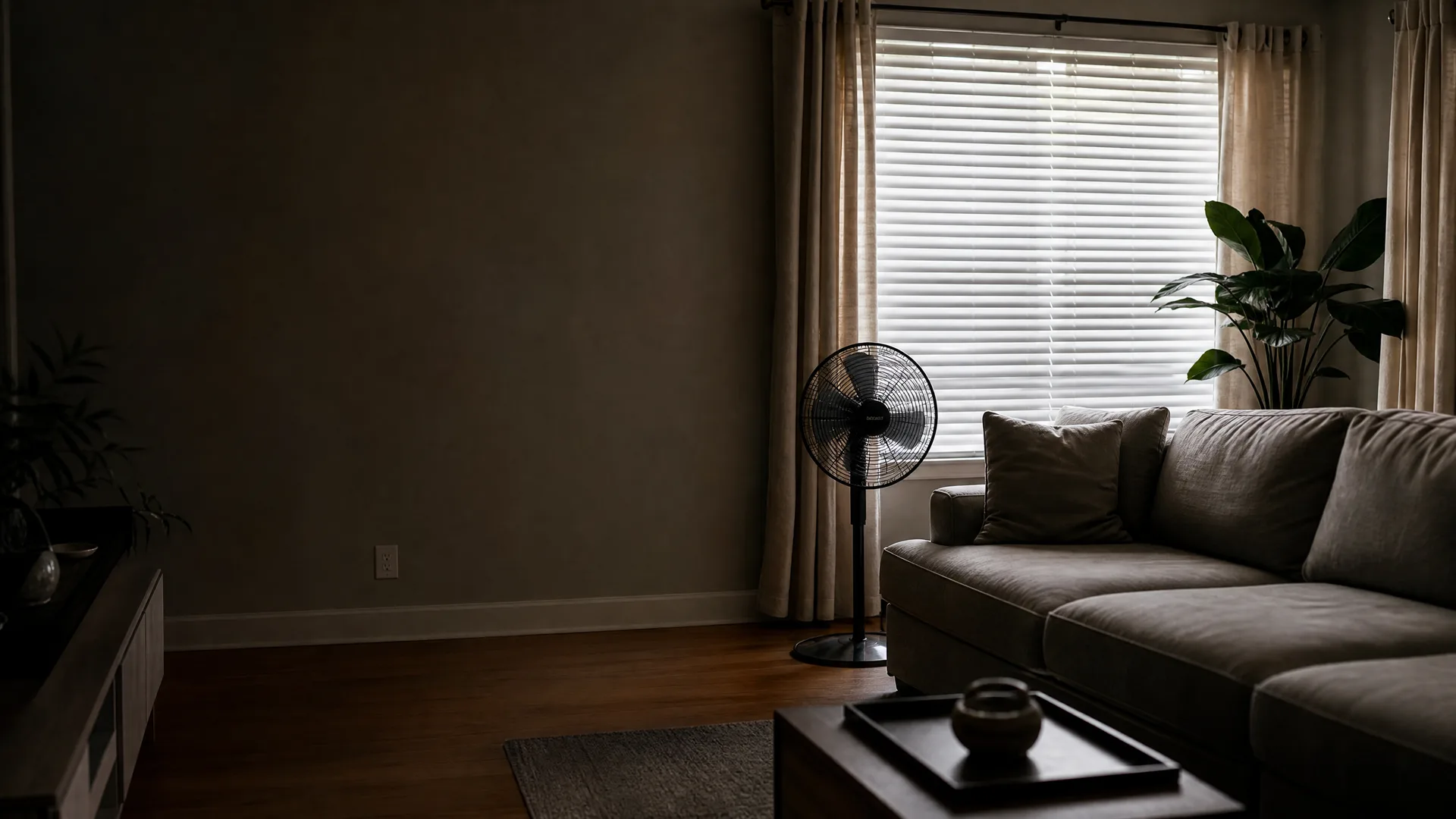
A dimly lit living room with a gray sectional sofa, a standing pedestal fan, a curtained window with blinds, a potted broad-leaved plant, a wooden coffee table with a tray and lidded jar, and a rug on dark wood flooring.

It's gone three in the afternoon and the blinds are shut against the sun, the kind of light that still finds its way around the edges. The floor fan by the couch is turning on full, pushing the same warm air around the room. You've checked the thermostat twice already, same number both times. Somewhere behind the wall the indoor fan keeps running, and you can hear it, but nothing coming out of the vents feels any different than the air already in the room. Outside, past the window, the unit sits still. No hum. The kids are on the floor in front of the fan because it's the coolest spot they've found.

An air conditioner pro near you

Send the request and finding a pro stops being your problem.

No fee to send it, and nothing to sign.

Why the heat makes it worse

A failing capacitor can still limp along in March. By July, with the outdoor unit sitting in direct New Mexico sun and the compressor working against a much bigger temperature difference, that same weak capacitor often can't deliver the jolt the motor needs to start. High-limit switches work the same way. A unit that trips on the hottest part of the afternoon and resets by evening isn't broken in a simple sense, it's overheating under a load it can't keep up with, and that points at low refrigerant, a dirty coil, or a motor nearing the end of its life.

What the breaker tells you

Check the breaker before anything else. If it's tripped, reset it once. If it trips again right away, something is pulling too much current, likely the compressor itself or a short in the wiring to the unit, and resetting it again won't help. If it holds but the compressor still won't start, the problem is further down the line: the capacitor, the contactor, or a safety switch. A breaker that holds steady rules out a whole category of causes and narrows down what a contractor needs to test first.

An older woman with gray hair in a bun and glasses, wearing a beige knit sweater, smiles while looking to the side in a warmly lit kitchen, with a loaf of bread on the counter in the foreground and a snowy scene outside the window.
A woman and a sleeping child wrapped together in a cream knitted blanket on a couch, with a potted plant, framed photo and lit lamp in the background.
A two-story gray horizontal-siding house with multiple gables, a covered front porch with white columns and railing, and a dark front door, fronted by a patchy green and brown lawn under a clear blue sky.

New Mexico air is dry, but it still carries some moisture, and across June, July and August it averages a dew point of 45°F where homes in the state sit, according to NOAA climate data. That's low compared to the Gulf states, and it's part of why a working air conditioner here feels like it's keeping up. It also means your compressor isn't fighting humidity the way one in a muggier state would. So if it won't start, the heat itself is the load it's up against, not moisture soaking into the coil or the air. A dry-heat failure usually traces back to the electrical side: the capacitor, the contactor, or a safety switch, not a system drowning in humidity.

NASA POWER T2MDEW county cells weighted by homes

Call Now or Check First?

Call for repair now

  • The outdoor unit is completely silent, no hum, no click, and the indoor fan is blowing air that isn't cold.
  • The breaker for the AC has tripped more than once, which points to a short or a compressor drawing too much current.
  • You can smell something burning near the outdoor disconnect box or hear a faint buzzing with no fan movement.
  • The thermostat is set below room temperature and calling for cooling, but nothing outside responds at all.
  • Afternoon highs are pushing the indoor temperature up fast and someone in the house needs that heat managed, not just monitored.
  • It's been more than a day with no cooling and the warm air inside is no longer a minor inconvenience.

Wait and check first

  • The outdoor unit ran fine yesterday and this is the first time it's gone quiet.
  • You haven't checked the breaker panel yet or confirmed the thermostat batteries are good.
  • The air handler and fan are both working normally, only the compressor outside seems affected.
  • Nobody is home during the hottest part of the day, so a few hours of warm air inside isn't urgent.
  • It's early in the season and temperatures haven't hit the triple digits that push a weak part past its limit.
  • You want to rule out something simple, like a tripped switch at the disconnect box, before assuming it's the compressor itself.
An outdoor air conditioning condenser unit on a concrete pad beside a house with white horizontal lap siding, with an electrical disconnect box and insulated refrigerant line on the wall and a shrub over mulch to the right.

The unit doing its job

The condenser sits on its pad, lines running clean along the wall to the disconnect box. Nothing about it looks like work needs doing. It cycles on when the thermostat calls for it, runs for a while, shuts off. The shrub beside it hasn't been disturbed.

An outdoor air conditioner condenser unit on a concrete pad beside a house with light horizontal lap siding, with an electrical disconnect box and conduit on the wall behind it.

The unit that's stopped

Same pad, same wall, same disconnect box, but the unit's been out here a while and it shows. Weathering on the casing, lines running low along the foundation instead of up the wall. If the compressor inside has quit, nothing about the outside will tell you why. That takes someone opening it up.

Power costs 14.85 cents per kilowatt-hour statewide

At 14.85 cents per kilowatt-hour, a compressor that won't start isn't running up your bill, but one that short-cycles or strains against a bad capacitor is. When it's dead silent, the cost that matters is the heat building up in the house while it sits there.

EIA-861 2025 statewide residential average

What a silent compressor tells you

  • A silent outdoor unit with a warm-blowing indoor fan almost always traces back to lost power, a failed capacitor, or a safety switch doing its job.
  • A tripped breaker that keeps tripping, or a hum with no start, points to something a multimeter and a capacitor tester settle fast.
  • New Mexico's dry heat pushes a weak capacitor past the point it can still limp along, which is why these failures cluster in July and August.
  • None of these causes get better by waiting, and most get worse the longer the compressor sits idle against a full afternoon load.
  • A contractor who checks the contactor, the capacitor, and the pressure switches can usually tell you which one it is within the same visit.
  • Once you send the request, the search for someone qualified is off your plate, and that's often the part that felt heaviest.

A compressor that won't start is almost never a mystery once someone opens the disconnect box and gets a meter on it. It's lost power, a capacitor that's given out, or a safety switch that tripped for a reason. Those three cover nearly every case, and each one leaves its own sign: a dead unit with no hum at all, a hum that never turns into a start, or a breaker that keeps tripping no matter how many times you reset it. July and August are when this shows up most in New Mexico, because a capacitor that was already weak in May doesn't have anything left to give once the compressor is working against a full afternoon load. Heat doesn't create the failure. It finds the part that was already close to done.

None of this gets better on its own. A capacitor that's failing keeps failing. A safety switch that shut things down did it to protect the compressor, not to be difficult, and running the system hard against that switch doesn't help anything. The longer it sits, the more the house heats up and the more strain shows up elsewhere in the system once it's running again.

What you need is someone to check the contactor, test the capacitor, and read the pressure switches, which usually sorts out which of these you're dealing with in one visit. Send the request and that search is no longer sitting on your list.

An outdoor air conditioner condenser unit on a concrete pad beside a dark horizontal-lap sided house, with mulch beds, shrubs and ornamental grasses nearby.

A local pro for your air conditioner repair

After this form, you can stop searching for an air conditioner pro.

Step 1 of 3: Equipment